
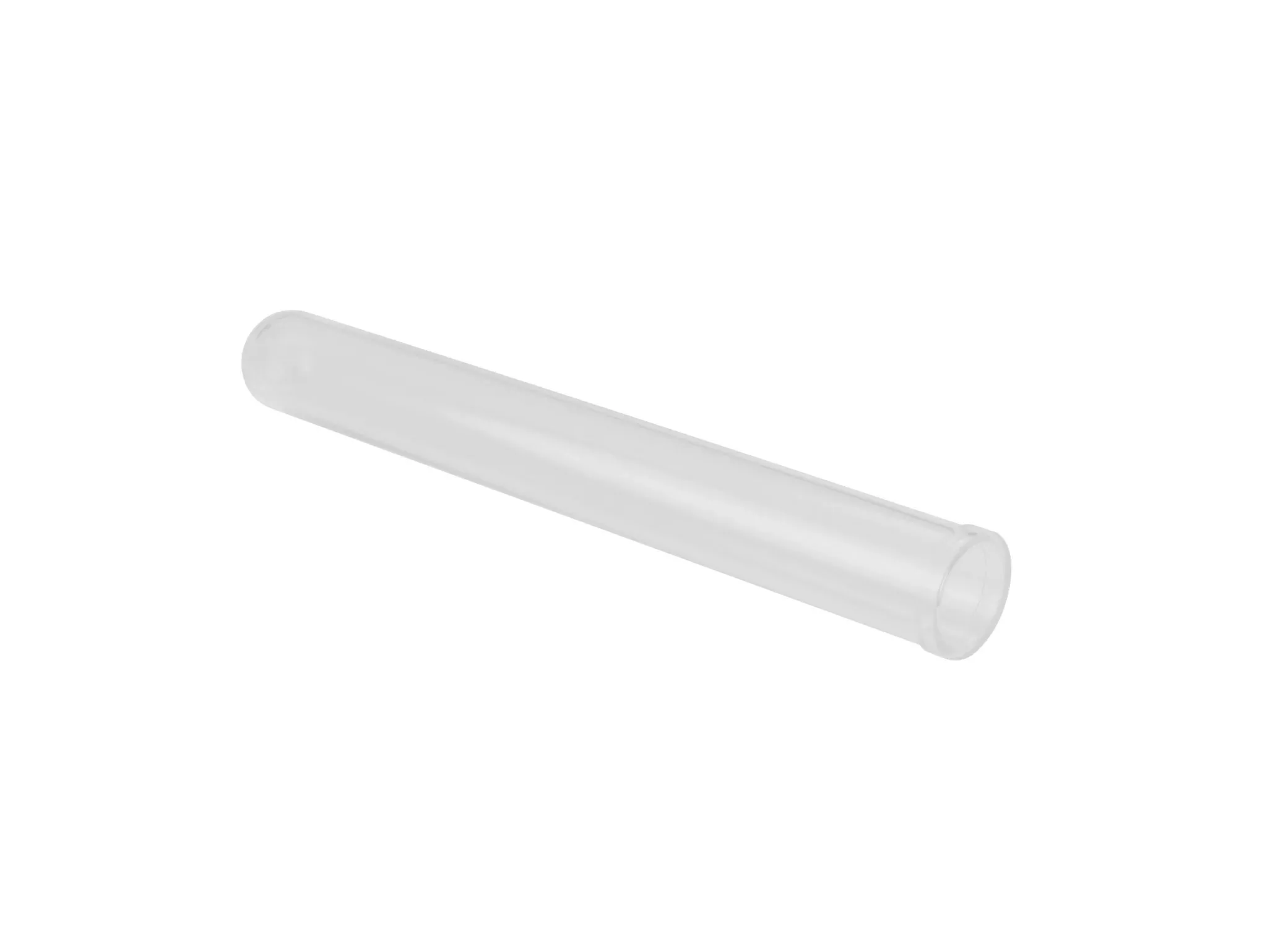
19 mL Round-Bottom PP Test Tubes, 16 × 125 mm — Natural, Non-Sterile, 1000/Bag (214-2345-03N)
These 19 mL polypropylene round-bottom test tubes measure 16 × 125 mm and are supplied non-sterile in bulk (1000/Bag) for high-throughput laboratory workflows. Manufactured from BPA-free, FDA-compliant polypropylene, they deliver broader solvent compatibility and higher thermal stability than polystyrene equivalents, making them the preferred choice for organic-modifier reaction systems, SPE eluate collection, and enzyme kinetics assays that exceed the chemical limits of PS tubes. Part number 214-2345-03N is available through LabSupplies.com, an authorized Caplugs® Evergreen dealer shipping from USA stock.
Technical Specifications
| Specification | Value |
|---|---|
| Part Number (MPN) | 214-2345-03N |
| Capacity | 19 mL |
| Dimensions | 16 × 125 mm |
| Geometry | Round Bottom |
| Material | Polypropylene (PP) |
| Color | Natural |
| Sterility | Non-Sterile |
| Pack Size | 1000/Bag |
| Thermal Rating | Up to ~80°C |
| BPA / Phthalate / Latex | BPA-Free, Phthalate-Free, Latex-Free |
| Country of Origin | USA |
Applications
- SPE eluate collection: Full compatibility with acetonitrile and methanol eluents at the 10–19 mL collection scale under standard SPE manifolds
- Organic solvent reactions: Bench-scale reactions and incubations with organic co-solvent buffer systems that are incompatible with polystyrene tubes
- Enzyme kinetics: Water bath incubation up to ~80°C with organic modifier co-solvents; exceeds the ~60°C thermal limit of PS equivalents
- Reagent and calibrator preparation: Multi-day storage of broad-solvent reagent matrices at the 19 mL working volume
- Colorimetric assays: Adequate PP optical clarity supports visual monitoring and spectrophotometric reading in the 400–700 nm range
- Centrifugation: Round-bottom geometry seats correctly in standard 16 × 125 mm clinical centrifuge adapters
- Pharmaceutical method development: Protocols requiring expanded acid/base tolerance (pH 2–12) and organic-modifier compatibility beyond PS limits
Chemical Resistance
| Reagent / Condition | Compatibility |
|---|---|
| Aqueous buffers / saline | Excellent — inert across pH 2–12 |
| Dilute acids (HCl, H₂SO₄, <10%) | Good — adequate for SPE wash steps and reaction media |
| Dilute bases (NaOH, <10%) | Excellent — preferred over PS for caustic reagents |
| Methanol / acetonitrile (<100%) | Excellent — full compatibility with organic modifier eluents |
| Alcohols (ethanol, isopropanol) | Good — short-term contact compatible |
| Chlorinated solvents (chloroform, DCM) | Not recommended |
| Aromatic solvents (toluene, xylene) | Not recommended |
Quality & Procurement
Made in USA from FDA-compliant, food-contact-grade polypropylene resin, these tubes are BPA-free, phthalate-free, and latex-free. Caplugs® Evergreen manufactures under ISO 9001 quality management, and the single-use format eliminates washing steps and cross-contamination risk between samples. LabSupplies.com is an authorized Caplugs® Evergreen dealer shipping from USA inventory, typically same business day for stocking items.
Frequently Asked Questions
What is the maximum temperature these tubes can handle?
Polypropylene is rated to approximately 80°C, making these tubes suitable for water bath incubations at temperatures that would deform or fail polystyrene equivalents, which are typically limited to around 60°C.
Can these tubes be used with acetonitrile or methanol eluents?
Yes — polypropylene offers full compatibility with acetonitrile and methanol at concentrations up to 100%, which is why this format is the standard choice for SPE eluate collection and organic-modifier reaction workflows where PS tubes are not appropriate.
Are these tubes sterile?
No — they are supplied non-sterile in 1000/Bag bulk packaging. This format is intended for chemical, analytical, and biochemical workflows where sterility is not required. Contact us if your application requires a sterile alternative.
What is the difference between these PP tubes and the PS 19 mL round-bottom tubes?
Both formats share the same 16 × 125 mm geometry and 19 mL capacity, but polypropylene provides significantly broader solvent compatibility (including organic modifiers and caustic bases), a higher thermal ceiling (~80°C vs. ~60°C for PS), and resistance across pH 2–12. Polystyrene is preferred only where optical clarity and lower cost are priorities and no organic solvents are involved.


